

Blogs
How to Make Revision Flashcards for Better Exam Revision

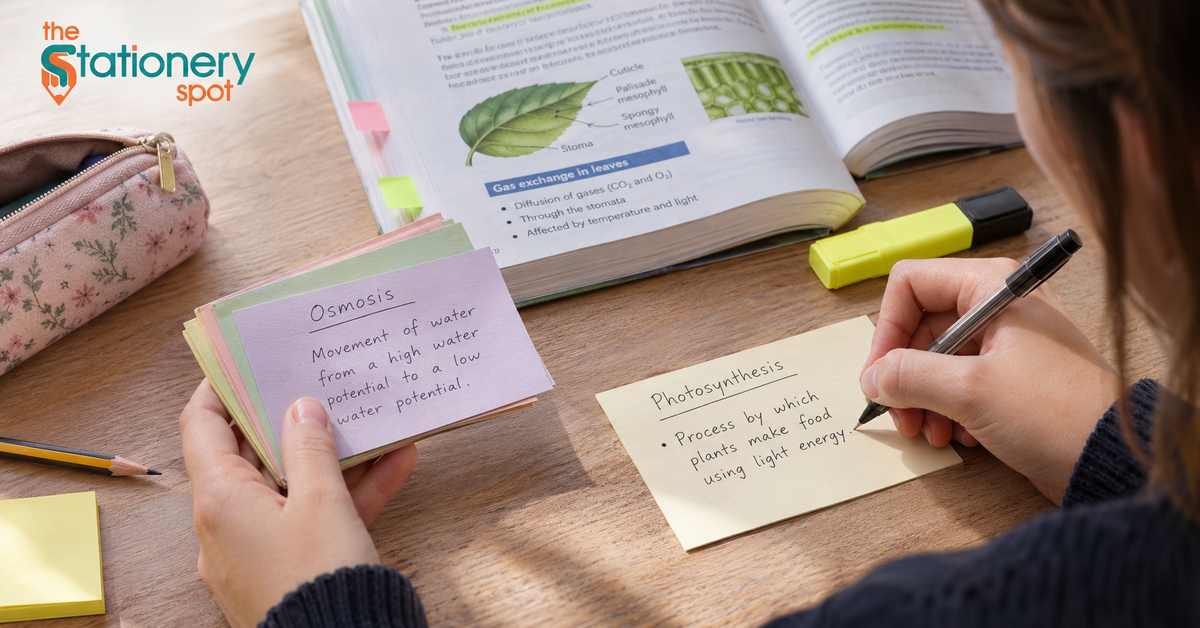
Learning how to make revision flashcards is a simple way to remember important information and prepare for exams more effectively. By writing a question on one side and its answer on the other, students can test their knowledge, practise active recall and review difficult topics regularly.
Whether you are preparing for school exams, college assessments or university finals in Pakistan, well-organised flashcards can make daily revision more focused and manageable.
What Are Revision Flashcards and How Do They Work?
Revision flashcards are small cards containing a question, keyword, formula or concept on one side and its answer or explanation on the other. Students look at the question, try to remember the answer and then turn the card over to check their understanding.
For example:
- Front: What is photosynthesis?
- Back: The process by which green plants use sunlight, water and carbon dioxide to produce glucose and oxygen.
Unlike simply reading a textbook or copying notes, flashcards encourage students to retrieve information from memory. This technique is called active recall.
Flashcards are useful for:
- Memorising English and Urdu vocabulary.
- Learning biology definitions and scientific terms.
- Remembering mathematical formulas.
- Revising history dates and important events.
- Understanding business and university concepts.
How to Make Revision Flashcards Step by Step
Creating useful flashcards does not require expensive equipment. Students can make them at home using index cards, blank paper or suitable stationery.
Follow these steps to create a practical revision set.
1. Choose One Topic at a Time
Start with a single chapter or subject instead of trying to cover your entire syllabus at once.
For example, a biology student studying human digestion can create separate cards for:
- Functions of the stomach.
- Role of the small intestine.
- Digestive enzymes.
- Nutrient absorption.
Keeping topics separate makes revision easier and helps students identify which chapters need more attention.
2. Write One Question on Each Card
Write a clear question, keyword or problem on the front of the card. Add its answer on the back.
Avoid putting several unrelated questions on one card.
Example – English Vocabulary
| Front |
Back |
| What does “Abundant” mean? | Available in large quantities |
| What is the opposite of “Ancient”? | Modern |
| What does “Brief” mean? | Short in duration or length |
This approach works particularly well for students learning new vocabulary for English examinations.
3. Keep Answers Short and Clear
One of the biggest mistakes students make is writing too much information on a single flashcard.
A useful flashcard should test one main idea. If an answer requires a full paragraph, divide it into smaller questions.
For example, instead of writing an entire chapter about the human heart, create individual cards about:
- What is the main function of the heart?
- How many chambers does the human heart have?
- What carries oxygen-rich blood from the lungs?
- What is the function of the heart valves?
Short questions make it easier to test your knowledge without feeling overwhelmed.
4. Use Colours to Organise Different Subjects
Colour coding can make revision cards easier to organise, especially when preparing for multiple subjects during exam season.
You can use:
- Blue for English vocabulary.
- Green for biology definitions.
- Yellow for mathematics formulas.
- Pink for important dates and historical events.
Use different coloured pens or highlighters to make important terms stand out. However, avoid decorating every card so heavily that the actual information becomes difficult to read.
Students can also explore bullet journal supplies for ideas on organising their study materials.
Use Active Recall to Test Your Memory
Active recall means trying to remember information without looking at the answer first.
It is one of the most useful ways to practise with revision flashcards.
Here is a simple method:
- Pick a flashcard from your revision deck.
- Read the question carefully.
- Try to answer it without checking your notes.
- Turn the card over and compare your answer.
- Put difficult cards in a separate review pile.
For example, if you are studying mathematics, look at a formula question and try to write the formula from memory before checking the back.
If you cannot remember the correct answer, review the card again later rather than immediately moving on.
Apply Spaced Repetition for Better Revision
Spaced repetition means reviewing information at increasing intervals instead of studying everything repeatedly in one sitting.
It helps students revisit difficult concepts before they are completely forgotten.
A simple revision schedule could look like this:
| Review session | When to review |
| First review | Same day |
| Second review | Next day |
| Third review | After 3 days |
| Fourth review | After 7 days |
| Fifth review | After 14 days |
This is a flexible example, not a fixed scientific rule. Review cards more frequently if you continue getting their answers wrong.
During Pakistani school and college exam seasons, students can use this approach to spread revision across several weeks instead of trying to memorise every chapter the night before an examination.
Practical Flashcard Examples for Different Subjects
The best way to understand flashcard making is to see how it works across different subjects.
Biology Flashcard Example
Front of card
What is the function of red blood cells?
Back of card
They transport oxygen from the lungs to body tissues using haemoglobin.
Biology flashcards are particularly useful for definitions, organ functions, scientific processes and differences between related terms.
Mathematics Flashcard Example
Front of card
What is the formula for the area of a circle?
Back of card
Area = πr², where r is the radius.
For mathematics, include formulas, properties and short practice problems. Try solving the question before checking the answer.
English Vocabulary Flashcard Example
Front of card
What is the meaning of “Generous”?
Back of card
Willing to give or share more than expected.
Language learners can use this technique for synonyms, antonyms, grammar rules, idioms and new vocabulary.
How to Choose the Right Flashcard Materials
You do not need complicated supplies to make effective revision cards. However, choosing suitable materials can make them easier to write on, handle and reuse.
| Material | Best use |
| Index cards | Everyday revision |
| Thick paper | Durable handmade cards |
| Coloured cards | Organising multiple subjects |
| Ring-bound cards | Keeping cards together |
| Highlighters | Emphasising key information |
Students can explore the School Supplies collection to find useful study materials.
For everyday revision, Flash Cards are a convenient option because they provide a ready-made surface for writing questions and answers.
If you prefer making your own cards, consider the paper thickness. Suitable gsm paper for printing can help you create cards that are easier to handle and less likely to bend during regular use.
You can also keep your subject notes organised in Note Books and use a separate set of cards for quick revision.
For university students, choosing suitable University stationery can make it easier to organise notes, assignments and revision materials together.
Printable Flashcard Template for Students
Students who prefer handmade revision cards can use the following simple template. Print it on suitable paper, cut along the card boundaries and write questions and answers on opposite sides.
Revision Flashcard Template
PRINTABLE STUDY RESOURCE · FRONT AND BACK
FRONT
Subject: __________
Topic: __________
Question:
BACK
Answer:
Example:
Tip: Print multiple copies, cut them into individual cards and write one question per card.
How to Organise Your Flashcards
Once your cards are ready, divide them into three groups:
- Easy: Questions you can answer confidently.
- Needs practice: Questions you sometimes forget.
- Difficult: Questions you cannot answer correctly yet.
Review difficult cards more frequently and move them into the easy group once you can answer them consistently.
A small storage box or organised pencil case can also help prevent cards from getting lost. Keep each subject’s cards together so you can find them quickly before a study session.
Common Flashcard Mistakes Students Should Avoid
Even well-prepared flashcards may not be useful if they are poorly designed or used incorrectly.
Avoid these common mistakes:
- Writing too much: Long answers make cards difficult to revise quickly.
- Reading without testing: Always attempt to answer before turning the card over.
- Making unclear questions: Each card should focus on one specific concept.
- Ignoring difficult cards: Spend more time reviewing information you cannot remember.
- Creating too many cards at once: Start with important concepts and gradually build your collection.
- Only revising before exams: Use spaced repetition throughout the school or college term.
Conclusion
Learning how to make revision flashcards can help students develop better study habits, improve memory and prepare more confidently for examinations. The most effective approach is to write short question-answer cards, practise active recall and review difficult information using spaced repetition.
Whether you are studying biology, mathematics, English or university subjects, start with a few well-designed cards and build your revision collection gradually. Choose suitable stationery, keep your cards organised and make regular practice part of your daily study routine.
Explore The Stationery Spot for useful flashcards, paper, notebooks and other study essentials to make your revision sessions more organised and productive.
Frequently Asked Questions
How many flashcards should I make for one chapter?
There is no fixed number. Create enough cards to cover the important definitions, concepts, formulas and questions in the chapter. Focus on understanding rather than making hundreds of unnecessary cards.
Are handwritten flashcards better than digital flashcards?
Both can be useful. Handwritten flashcards offer a simple, screen-free revision method, while digital cards are convenient for students who prefer studying on their phones or computers.
When should I start using flashcards before exams in Pakistan?
Start making flashcards while studying each chapter rather than waiting until exam week. Review them regularly throughout the term and increase revision frequency as your examination date approaches.
What is the best paper for making revision flashcards?
Thicker paper or index cards are generally suitable because they are easier to handle and less likely to bend. Choose a smooth writing surface that works well with your preferred pen or marker.
Can flashcards help university students?
Yes. University students can use flashcards to remember technical terminology, research concepts, medical definitions, business theories and important formulas. They are particularly useful for subjects that require frequent recall of specific information.