

Blogs
Types of Notebooks: Ruled, Plain or Squared Which One Should You Buy for Each Subject?

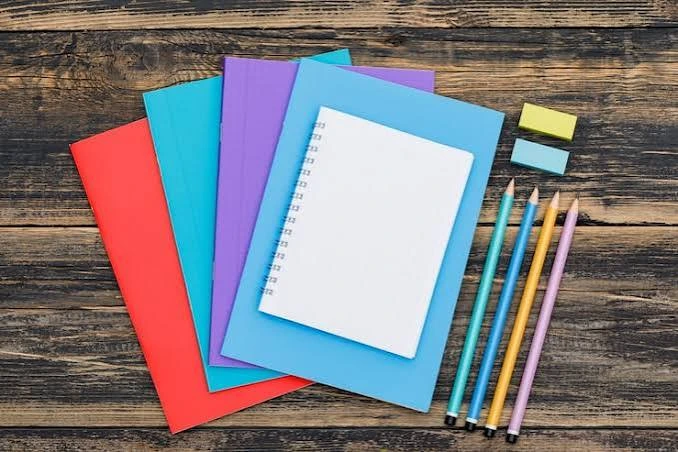
The best notebook depends on what you study. Ruled notebooks are suitable for English, Urdu, and theory subjects, squared notebooks help with math and calculations, and plain notebooks work well for drawing and diagrams. Graph notebooks are useful for plotting data, while dotted notebooks offer flexible layouts for mixed notes and diagrams.
With so many types of notebooks available in Pakistan, choosing the right one can become confusing, especially during back-to-school shopping. A parent buying copies for Class 3 has different requirements from an FSc student preparing practical files or a university student attending lengthy lectures.
Before picking up a stack of notebooks, it helps to understand what each type is designed for and whether it suits your subjects.
5 Types of Notebooks and What Makes Each One Different
The main difference between notebooks is their page layout. The lines, squares, dots, or blank spaces influence how easily you can write, calculate, or draw.
1. Ruled Notebooks: Best for Writing-Based Subjects
Ruled notebooks have horizontal lines that help keep handwriting straight and evenly spaced.
They are the most practical choice for subjects involving paragraphs, explanations, essays, and classroom notes.
Best for: English, Urdu, Islamiat, Pakistan Studies, History, and other theory subjects.
For younger children, wide-ruled or four-line notebooks may be appropriate, depending on the school’s handwriting requirements. Older students generally use single-line notebooks or registers. If you’re unsure about your child’s requirements, check the school’s booklist before purchasing.
2. Plain Notebooks: Best for Drawing and Diagrams
Plain notebooks contain blank pages without printed lines or grids.
They give students the freedom to draw large diagrams, make illustrations, and arrange information without restrictions.
Best for: Art, drawing, biology diagrams, and visual classroom activities.
A plain notebook is useful for students who need to draw scientific diagrams or practice sketching. However, some schools require ruled practical notebooks with a blank page opposite the writing page, so always check the specified format.
Students buying pencils for artwork can also compare pencil grades HB 2B 6B to select suitable options for outlines and shading.
3. Squared Notebooks: Best for Math and Calculations
Squared notebooks have evenly spaced horizontal and vertical lines forming small squares.
The grid makes it easier to align numbers, write calculations in columns, and draw simple geometric shapes.
Best for: Mathematics, basic geometry, accounting calculations, and arithmetic practice.
Squared notebooks are particularly helpful for primary and middle school students learning multiplication, division, and place value.
Students using rulers, compasses, and other mathematical instruments can refer to the geometry box checklist for students in Pakistan before purchasing their supplies.
4. Graph Notebooks: Best for Charts and Scientific Data
Graph notebooks contain grids designed for accurate plotting and measurement. Some have darker major lines and smaller subdivisions, making scales easier to follow.
Although squared and graph notebooks look similar, graph paper is generally better suited to plotting coordinates, experimental readings, and scaled diagrams.
Best for: Mathematics, Physics, Statistics, Economics, and technical subjects.
For example, an FSc Physics student may need graph paper to plot readings from a practical experiment. Mathematics students may use it for coordinate geometry and functions. Check whether the teacher requires a separate graph notebook, loose graph sheets, or a particular grid size.
5. Dotted Notebooks: Best for Flexible Academic Notes
Dotted notebooks have small dots printed at regular intervals instead of continuous lines.
The dots provide light guidance for keeping writing, tables, and diagrams aligned without making the page look crowded.
Best for: University lecture notes, business studies, flowcharts, and project planning.
A dotted notebook can be helpful when a subject combines written explanations with diagrams and tables. For students who mainly write long paragraphs, however, a standard ruled notebook is usually simpler.
Notebook Comparison Chart: Which Type Is Best for Each Subject?
Choosing a notebook becomes easier when you match its layout to the kind of work you complete most often.
| Subject | Recommended notebook | Why it works |
| English and Urdu | Ruled | Keeps sentences and paragraphs aligned |
| Islamiat and Pakistan Studies | Ruled | Suitable for written explanations |
| Mathematics | Squared | Helps align numbers and calculations |
| Physics | Ruled + graph | Supports theory notes and plotted data |
| Chemistry | Ruled + plain/graph as required | Accommodates equations and practical work |
| Biology | Ruled + plain | Suitable for notes and labeled diagrams |
| Accounting | Squared or ruled | Helps organize numerical entries |
| Art and Drawing | Plain | Allows unrestricted sketching |
| Statistics and Economics | Ruled + graph | Useful for written concepts and graphs |
| Engineering | Squared, graph, or specialized drawing paper | Supports calculations and technical diagrams |
These recommendations are starting points. In Pakistan, individual schools and colleges often specify notebook sizes, ruling styles, page counts, and practical-book formats.
Long Book vs Register: What’s the Difference?
In Pakistani stationery shops, you will frequently hear the terms long book, copy, and register. They can refer to different products depending on the retailer.
A long book generally refers to an elongated school exercise notebook, often used for regular classwork or homework. A register is commonly a thicker notebook with more pages, suitable for extended note-taking.
| Feature | Long book | Register |
| Common use | School classwork and homework | College, university, and office notes |
| Page count | Often fewer pages | Often higher page counts |
| Portability | Usually lighter | Can be heavier |
| Writing space | Depends on dimensions | Depends on dimensions |
| Best choice | Subject-specific schoolwork | Lengthy notes over a term or semester |
Registers in Pakistan are sold in different sizes and page counts, so the label alone does not determine capacity. For Matric and Intermediate students, a separate register for each major subject can make revision easier. University students may prefer one register with dividers for related courses.
How to Choose the Right Notebook: Pages, GSM, and Binding
How Many Pages Should a Notebook Have?
A 40–80-page notebook may be enough for short assignments or a subject with limited written work. For regular schoolwork, 100–200 pages can be more practical. Students preparing extensive college notes may need larger registers or multiple notebooks during a session.
Check whether the seller counts individual sides as pages or sheets of paper. A notebook containing 100 sheets has 200 writable sides.
What Does Paper GSM Mean?
GSM stands for grams per square meter. It measures paper weight, although it does not directly measure thickness or guarantee ink resistance.
| Paper GSM | Typical suitability |
| 60–70 GSM | Basic handwriting using pencils or ballpoint pens |
| 75–80 GSM | Everyday classroom and office notes |
| 90–100 GSM | Students who prefer heavier paper or use wetter inks |
| 120 GSM and above | Drawing and heavier applications, depending on the medium |
Higher-GSM paper often reduces show-through, but ink performance also depends on the paper finish and ink formulation.
If you use gel pens or fountain pens, test a page before purchasing several notebooks. You can also read our comparison of ballpoint pen vs gel pen vs fountain pen to understand how different inks behave.
Which Binding Type Is Better?
- Stapled or pinned: Usually economical and suitable for smaller school copies.
- Spiral-bound: Opens easily and often folds back, making it convenient for lectures.
- Thread-sewn: Can offer good durability for frequent use, depending on construction.
- Glue-bound: Provides a neat finish but may be less convenient for notebooks that must open flat.
For young schoolchildren carrying several books every day, lightweight notebooks are generally more practical than heavy registers.
Budget vs Premium Notebooks: Which Offers Better Value?
An expensive notebook is not automatically the right choice. For primary and secondary students, ordinary notebooks with readable ruling, secure binding, and paper suitable for everyday writing are often sufficient.
College and university students may benefit from stronger covers, improved binding, and better paper if they use the same register for several months.
When comparing prices in PKR, check the cost per sheet rather than the notebook’s price alone. A cheaper notebook with fewer sheets may offer less value.
If you’re preparing for a new academic session, use the school stationery list in Pakistan to avoid buying notebooks your child does not need.
University students can also consult the university student stationery list for additional lecture and assignment supplies.
Make Your Next Notebook Purchase Count
Understanding the different types of notebooks helps you buy stationery that suits your subjects, writing habits, and budget.
Choose ruled pages for everyday writing, squared pages for calculations, plain pages for artwork, graph pages for plotting, and dotted pages when you need flexible academic layouts. Check the page count, paper quality, and binding before making your final choice.
Explore The Stationery Spot for notebooks, registers, writing supplies, and other school essentials. You can also browse school supplies online with cash on delivery to plan your next stationery purchase from home, subject to checkout availability.
Frequently Asked Questions
1. Which notebook is best for school students in Pakistan?
Ruled notebooks are suitable for most writing subjects, while squared notebooks are useful for mathematics. Art usually requires plain pages, and science subjects may need graph paper or specially formatted practical notebooks. Follow the school’s prescribed booklist.
2. What is the difference between a squared notebook and a graph notebook?
Both contain grids, but squared notebooks are mainly used for calculations and aligned writing. Graph notebooks are designed for plotting data and measurements, often with smaller subdivisions or more prominent grid intervals.
3. Is a 70 GSM or 80 GSM notebook better for students?
Both can work for everyday handwriting. An 80 GSM notebook may feel more substantial and reduce show-through compared with some 70 GSM papers. The actual performance depends on paper quality and the pen being used.
4. Should college students buy long books or registers?
Registers are often more convenient for lengthy lecture notes because they are available with higher page counts. Long books may be sufficient for shorter subjects or assignments. Choose according to the required size, page count, and portability.
5. Are spiral notebooks better than regular notebooks?
Spiral notebooks can be easier to open flat or fold back while writing, making them useful during lectures. Stapled or sewn notebooks may be simpler to carry and store. The best option depends on binding quality and how frequently the notebook will be used.